
How To Overcome The Fear Of Kitesurfing
Being afraid of kitesurfing is normal, and the fear fades when you combine a good instructor, sensible conditions and plenty of kite-control practice before you ever stand on a board.
Afraid of kitesurfing? An instructor explains how to beat the fear, what injury data really shows, and which lessons, gear and winds keep you safe.
When I first saw a kite on the beach, it was love at first sight. I couldn't start learning right away because there was no kitesurfing school nearby, so I went home from that holiday and spent weeks glued to my screen, searching for information, photos, videos and tips.
Years later, as an instructor, I realised that many people share that desire to learn, but not everyone believes they can. A second group of readers are the partners of kitesurfers (girlfriends, boyfriends, wives, husbands) who are often nudged to try it by their other half.
The fear of a kite's power comes from not yet knowing how to control it. Once something is firmly under your control, it stops being scary. The catch is that you have to practise exactly the thing you fear in order to get there.
Two things cause most of the fear, and each has a practical answer: the power of the kite itself, and the crash stories you hear or read.
#1 Afraid of the kite's power? Build control step by step
Every student needs their own pace and their own approach, but learning any new sport follows the same loop:
- Choose a skilled instructor (here, a certified kitesurfing instructor).
- Try to put what they say into practice.
- Fail.
- Get feedback from your instructor.
- Try again, and perhaps fail again.
- Repeat steps 4 and 5 until you complete the exercise correctly.
- Make the action automatic, so you can do it with confidence and move to the next step.
The last step matters most. In kitesurfing, repeat the body drag as many times as you need to feel completely comfortable with the kite before you try to stand on a board. That comfort is what replaces the fear.
Start with a trainer kite. A 2-3 m trainer kite lets you learn steering, the wind window and the feel of power on the beach, with far less pull than a full-size kite. Many schools suggest a few hours on one before your first lesson, and it can shorten your time on the water.
Know what the lessons will cover. Beginner courses at IKO schools follow Levels 1-3 (Discovery, Intermediate, Independent). Level 1 covers safe wind directions and conditions, spot hazards, safety systems, basic trainer-kite flying, the wind window, and setting up and checking a full depower kite. Level 2 adds kite power management, body dragging and self-rescue. Level 3 is your first session with the board. Knowing the map in advance makes each step less of a surprise.
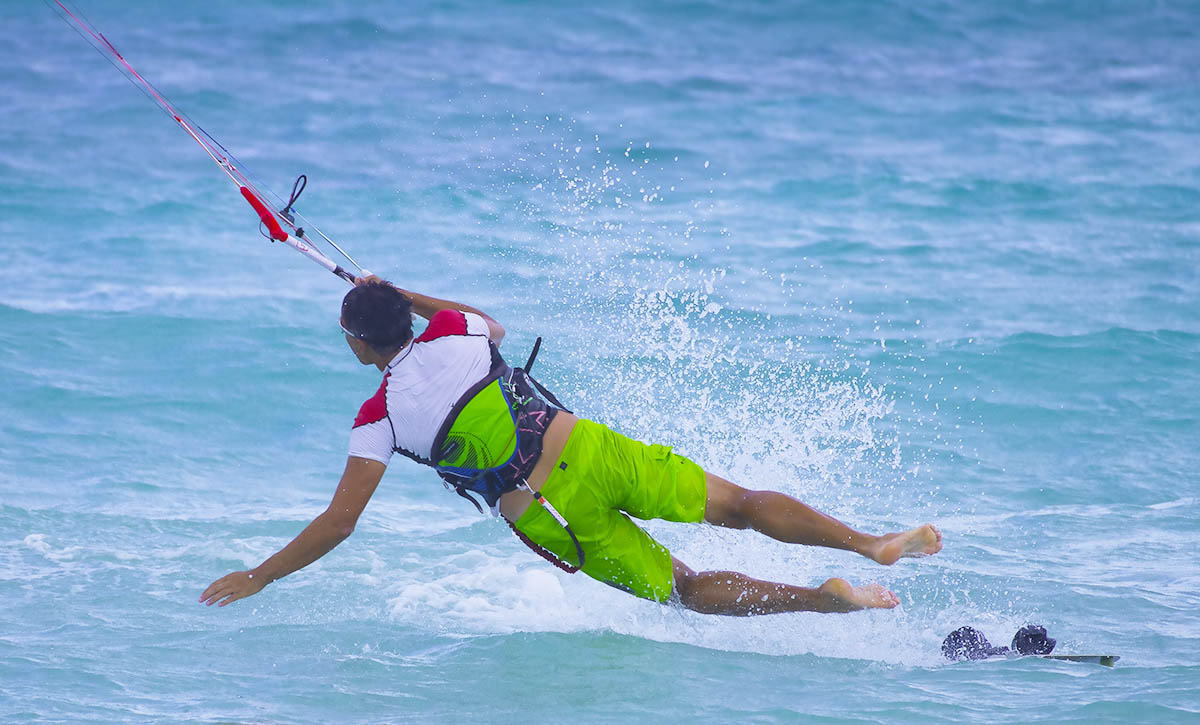
Body drag until it is boring. Being dragged through the water by the kite, with no board involved, is the safest way to feel its power, and the skill of dragging upwind is what gets you back to your board or past small waves. Even after you ride, going back to body dragging is a good way to rebuild confidence in new conditions or after a scare.
Talk to your instructor. Tell them what you feel and where you doubt yourself. The more feedback you give, the better they can guide you, and your mistakes are exactly the information they need. Sometimes you will think you can't do what is asked, and you'll be surprised by what you manage.
Learn to spot fear in your body. A tight grip on the bar and tense arms reduce your feel for the kite, and instructors watch for exactly these signs. When you notice them, say so, loosen your hands and take a breath before the next attempt (Seabreeze instructor tips).
The recipe is simple: keep doing what scares you, in small steps and in the safest setting possible, until it doesn't scare you anymore.
A small study of 35 beginners on a six-day course found that courage correlated with how much they learned, while fear on its own showed no statistically significant link to learning progress. In other words, being scared at the start does not mean you will be a poor learner (Prlenda et al.).
2# Is kitesurfing dangerous? What the injury data shows
Headlines about kitesurfing accidents scare a lot of people off. Real data gives a more balanced picture, and it also shows where the risk actually sits.
A prospective study followed 194 Dutch kitesurfers of all levels through one full season, covering 16,816 hours on the water:
|
What the study found |
Figure |
|---|---|
|
Injury rate |
10.5 per 1,000 hours of kitesurfing |
|
Injuries that were cuts, abrasions or bruises |
about 45% |
|
Injuries after which the rider was back within a week |
83% |
|
Injuries that led to a hospital admission |
2.9% |
|
Injuries that happened during a jump or trick |
about half |
|
Injuries caused by a collision with another person |
2.8% |
|
Fatal injuries in the group |
none |
For context, the same paper cites injury rates of 18.5 per 1,000 hours in soccer and 22.7 in motocross, and concludes that kitesurfing is in the range of other popular contact sports (van Bergen et al., 2020). Two caveats: injuries were self-reported, and the definition counted every cut and scrape. Severe injuries, including spine and knee ligament injuries, did occur, so the sport is not harmless.
Three points matter for a nervous beginner:
- Most trouble comes from tricks and mistakes, not from the kite itself. Half the injuries in the Dutch study happened during jumps or tricks. In a smaller Norwegian review of 33 kiteboarding accidents, 82% were attributed to operator error or lack of experience (Torland et al., 2024).
- Beginners are not exempt. In the Dutch data, riders with under a year of experience had a higher injury rate (17.5 per 1,000 hours) than riders with more than ten years (7.8), though the difference was not statistically significant. Experience helps, and it is gained through proper training.
- How you learn matters. In a survey of 93 kiteboarders, 70% of self-taught riders reported an injury, against 43% of those who took a course with a licensed instructor. It is a small, self-reported sample, but it points the same way as everything else here (Czech survey).
So when you read about a serious accident, ask what the rider was doing and what they were missing: training, conditions, safety gear or a working quick release. Most of those factors are within your control, and the rest of this article is about exactly those.
3# Kitesurfing safety systems and gear that build confidence
Modern kites come with a depower system and a quick release you can operate with one hand. Knowing exactly what happens when you pull it removes a large part of the fear.
- Quick release and depower. Pulling the quick release above the chicken loop makes the kite lose most of its power. Practise the movement on the sand, then reassemble the system, until your hand finds it without thinking. Each brand works slightly differently, so learn your own (SurferToday).
- Know the limits. IKO points out that no safety system depowers a kite completely, especially in strong wind. It recommends the front re-ride setup and does not approve some alternatives such as OSR and asymmetric or mini fifth-line systems, which keep the front lines under tension (IKO).
- Actually use it. In the Dutch study, 98% of injured riders had a quick release, but it was used in only 7.3% of the injuries. The authors suggest that riders may hesitate to trigger it. Your instructor should make pulling it feel normal, and early is always better than late.
- Helmet and impact vest. In that same study, only 4% of riders wore a helmet and about 20% an impact vest on a regular basis. Norwegian researchers recommend that a kiteboarding course should stress using a helmet and a life vest in kitesurfing (Torland et al., 2024). A kitesurfing-specific impact vest also gives you flotation and protects the ribs. It does not make you invincible, so it should never push you to take risks you wouldn't otherwise take.
- Well-fitted gear. Gear that is too tight can add to anxiety, as some learners report. Ask your school to fit everything properly before you go out.
Putting on a helmet and vest, and rehearsing a quick release before every session, also works as a small ritual that tells your brain you are prepared.
4# Best wind conditions for beginner kitesurfers
A large share of fear is really fear of the wrong conditions. A good school will cancel a lesson rather than send you out in them.
- Wind strength. Beginners usually enjoy kitesurfing from about 14 knots (4 Beaufort), and from around 30 knots (6 Beaufort) even they struggle (Kiteworldwide). Steady wind is better than strong wind, and gusty days are a reason to stay on the beach.
- Wind direction. Side-shore or side-onshore wind is best for learning. Offshore wind is discouraged for beginners because drifting away from the shore happens faster than you expect and swimming back against the wind is hard. Directly onshore wind often brings shore break and the risk of being pulled over land. Experienced riders sometimes ride offshore, but only with a rescue service available.
- Space. Start where the water is flat and the beach is wide and uncrowded, with nothing hazardous downwind.
Learn the right-of-way rules early. They are a core part of Level 1 and they make crowded water far less intimidating. The basics, as taught by most schools:
- The upwind rider gives way to the downwind rider.
- The rider on port tack (left hand forward) gives way to the rider on starboard tack (right hand forward).
- A rider launching or landing gives way to riders already on the water.
- Riders lose their priority when they jump or perform tricks.
- Keep a downwind safety zone of about 50 m (twice your line length) from other water users and hazards.
Follow the rules, but don't rely on others knowing them: even with right of way, you must avoid the collision (SurferToday, Kiteboarding Australia). Local rules at your spot can differ, so ask your instructor.
5# How to choose a kitesurfing instructor
Your instructor is responsible for putting you at ease and for giving you the time you personally need. Look for:
- A recognised certification, such as IKO, and a school that tells you which level you reach after each lesson.
- Small groups. Many schools teach beginners one-to-one or two-to-one, so you get feedback on every attempt.
- Support on the water, such as a rescue boat, and gear that is adapted to your size and the day's conditions.
- Patience. If a lesson doesn't leave you relaxed and having fun, change instructor. You are there to learn, not to please the person you pay.
On the other hand, when a good instructor says you can do it, believe them, let go of the fear and try.
6# If you're here because your partner pushed you
It is fine to say you're nervous. Take lessons with a school rather than from your partner, so that nobody is teaching and being emotionally invested at the same time. Go at your own pace, and tell your instructor that you're trying kitesurfing because someone you love enjoys it. Plenty of people discover they enjoy it, and some decide it isn't for them. Both outcomes are fine.
Frequently asked questions about the fear of kitesurfing
Is it normal to be scared of kitesurfing?
Yes. A 2009 reader survey by Progression found that fear of injury and of wiping out were the two biggest barriers to progress, after weather (Progression). Fear usually turns into respect as your kite control improves.
Is kitesurfing dangerous?
It carries real risks, but a Dutch season study put the injury rate at 10.5 per 1,000 hours, comparable to other popular contact sports, with most injuries mild (van Bergen et al., 2020). Training, suitable conditions and working safety gear lower your risk.
Is kitesurfing hard to learn?
IKO suggests that the basics can take roughly 6-12 hours of lessons, and that mastering the sport takes years (IKO). The first stage, kite control, is where most of the work happens.
Do I need lessons?
Yes. In a small survey, 70% of self-taught kiteboarders reported an injury, against 43% of those who learned with a licensed instructor (Czech survey).
Do I need to be a strong swimmer?
You need to be comfortable swimming in deep water. IKO schools list this as a requirement for beginner courses (IKO school listing).
What if I panic on the water?
Tell your instructor, pull your quick release if you feel overpowered, and go back to body dragging until you feel calm. Going back a step is part of learning, not a failure.
Final thought
Enjoy every moment of the learning process. That is the best trick I know for making fear fade and leaving room for many hours of fun. Have fun!
Sources
- Kitesurf injury trauma evaluation study (van Bergen et al., World Journal of Orthopedics, 2020)
- Kitesurfing and snowkiting injuries in Norway (Torland et al., 2024)
- Relationship between fear and courage with the level of acquired knowledge in kiteboarding
- Injuries in recreational kiteboarders (Czech survey)
- IKO: how your kitesurf bar's safety system works
- SurferToday: how to quick release and depower a kite
- SurferToday: right-of-way rules in kiteboarding
- Kiteboarding Australia: safe kiteboarding guidelines
- Kiteworldwide: how much wind do I need to learn to kitesurf
- Progression: fighting the fear
- IKO: how long does it take to learn to kiteboard
- Seabreeze: instructor tips on fear
- IKO school listing: beginner course requirements

Travel Mug
Logo: Peace Balance Wind
Promote your Kite School for free!
Index your Kite School in our database.
You will get free lifetime visibility on Kitesurf Culture website.
If you have a website, it will provide precious backlinks to improve your SEO ranking
Relevant Posts
How to Perform at Your Peak and Prevent Kitesurfing Accidents?
How to get into Kitesurfing
Get free Kitesurfing Resources and Tips
If you like our content and you want to be informed on the next blogposts release, please subscribe here. That will also help us to continue to provide quality content:
Give us your opinion.
Comments

Kite Club Cabarete
Awesome post. Thanks for sharing this blog. It is a very informative and motivational blog for beginners. You have written clearly about how to overcome our fear of kite surfing. And how to find the solution to problems in fear. Kite Club Cabarete also offers the best IKO Instructor Training Courses in the UK. For more information, visit here: https://kiteclubcabarete.com/.
4 years ago
Flowy T-Shirt

Logo: When life gives you wind go kiting!
Promote your Kite School for free!
Index your Kite School in our database.
You will get free lifetime visibility on Kitesurf Culture website.
If you have a website, it will provide precious backlinks to improve your SEO ranking
Relevant Posts
How to Perform at Your Peak and Prevent Kitesurfing Accidents?
How to get into Kitesurfing
Flexfit Baseball Cap

Logo: Yoga Kite Love
Latest Posts
Kitesurfing Dubai: an honest guide. Tips, Spots & Winds

Unwind and learn: best beginner kitesurfing spots worldwide
Self-Rescue in Kitesurfing: A Crucial Guide to Safety

Kitesurf Ometepe: an Epic Kite Trip to Nicaragua

Kitesurfing Spring in Andalucia: Unexpectedly Great!