
Kitesurfing in Geraldton
Geraldton · Australia
Been here? Want to go? Add it to your kite spot lists.
Create a free account to save it- Spot type Wave
- Rider level beginner
- Water Dark - Clear
- Beach Sand
- Crowd Seasonal crowd
- Tide effect Conditions vary
Kitesurfing in Geraldton: Conditions, Wind & Season
Geraldton is one of Western Australia's most reliable kitesurfing destinations, situated along the Indian Ocean coastline approximately 420 kilometres north of Perth. The region is renowned for its powerful seasonal sea breezes, consistent ocean swells and diverse riding locations distributed along Australia's Coral Coast. Rather than being centred around a single beach, Geraldton offers several distinct kiteboarding spots, ranging from relatively protected flat-water sections to exposed reef breaks and open-ocean beaches. Coronation Beach, Point Moore, St Georges Beach, Sunset Beach, Separation Point and Tarcoola Beach provide different combinations of wind exposure, water depth and wave conditions. This variety allows riders to select their preferred location according to the prevailing wind, swell and riding discipline, making Geraldton particularly attractive for extended kitesurfing trips and experienced riders seeking consistent strong-wind sessions.
The main kitesurfing season extends from November through March, when powerful southerly and south-southwesterly sea breezes dominate the coastline. Suitable conditions can also occur during October and April, extending the effective riding season beyond the peak summer months. The thermal wind typically strengthens during the afternoon, frequently reaching between 20 and 30 knots, with particularly windy days exceeding 30 knots. South, southwest and occasionally southeast winds provide different riding opportunities depending on the orientation of each beach. The prevailing southerlies often create favourable starboard-tack wave-riding conditions along the exposed coastline. However, locations with a cross-offshore wind component require considerable experience and reliable recovery options. Small to medium-sized kites are particularly useful during the main season, and visiting riders should bring equipment capable of handling strong afternoon winds rather than relying exclusively on larger freeride kites. Autumn and winter generally bring less consistent wind conditions but more substantial Indian Ocean swells, occasionally providing excellent wave-riding opportunities when suitable winds accompany passing weather systems.
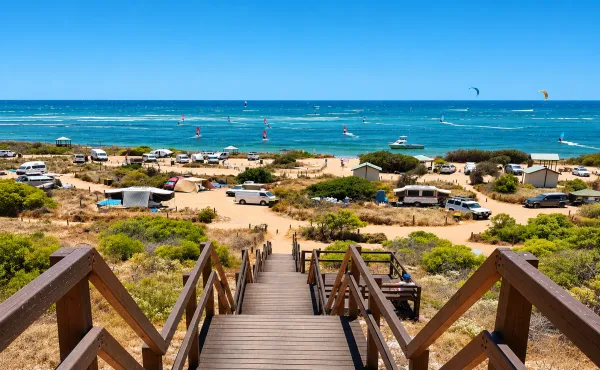
Coronation Beach, approximately 30 kilometres north of Geraldton, is arguably the region's most versatile kiteboarding location. Its combination of relatively protected inner water and offshore breaking waves allows riders to alternate between freestyle, powered freeriding and directional wave riding. The offshore reef formations influence wave development and require particular attention during lower tides. Point Moore, situated at Geraldton's westernmost tip, is considerably more exposed and frequently experiences some of the strongest winds in the area. Its combination of chop, reef formations and ocean swell makes it particularly attractive for experienced wave riders and big-air enthusiasts. St Georges Beach generally offers more manageable water conditions, with smaller waves and relatively sheltered sections suitable for freeriding and technical progression. Sunset Beach is another established wave-riding location, particularly when favourable ocean swells combine with the prevailing southerly winds. Separation Point and Tarcoola Beach provide additional alternatives, with varying degrees of exposure to wind and swell. Together, these locations give Geraldton an exceptional range of riding environments within relatively short driving distances.
Water conditions throughout the region vary from relatively smooth coastal sections to powerful breaking waves over offshore reefs and shifting sandbanks. Although many launching beaches feature sandy shorelines, the seabed is not uniformly sandy, and limestone reefs, submerged rocks and seagrass-covered sections are common along parts of the Geraldton coastline. Tidal variations are generally less restrictive than at extensive tidal-flat destinations, but water depth over reef formations can significantly influence riding safety and wave quality. Directional surfboards are particularly well suited to the exposed beaches, while twin-tip riders can enjoy powered freeriding, freestyle and big-air sessions in appropriate areas. The combination of strong winds and natural wave ramps makes Geraldton an excellent destination for experienced big-air riders. Hydrofoiling is possible in deeper, unobstructed sections, although the frequently powerful winds and extensive reef formations make conventional equipment more practical during much of the main season.
Access to most kiteboarding locations is straightforward, with public parking and established beach entrances available around Geraldton's urban coastline. Coronation Beach is reached via the North West Coastal Highway and Coronation Beach Road, with designated wind sports areas and basic facilities near the campground. Launching conditions vary considerably between locations, ranging from broad sandy beaches to relatively narrow rigging areas affected by dunes, vegetation and local wind turbulence. The region attracts substantial numbers of visiting kitesurfers and windsurfers during the summer months, particularly at Coronation Beach and other established launches. Riders should respect designated launching zones and maintain appropriate separation between different water sports disciplines. Geraldton also offers access to specialist equipment shops and repair services, making it a practical base for longer kiteboarding trips. Despite the warm summer air temperatures, the Indian Ocean water and strong afternoon winds make a shorty or 3/2 mm wetsuit useful during much of the main season, while thicker wetsuits are recommended during winter. Reef booties may provide additional protection at locations with rocky or reef-covered access points.
The principal hazards around Geraldton include exceptionally strong winds, submerged reef formations, powerful shorebreak, rip currents and turbulent airflow near certain launching areas. Wind strength can increase considerably throughout the afternoon, making appropriate kite selection particularly important. Riders should avoid jumping over shallow reefs and carefully assess unfamiliar beaches before entering the water, especially where cross-offshore winds or strong currents could complicate self-rescue. The exposed wave-riding locations require confident kite control, reliable upwind ability and experience recovering equipment in breaking waves. Beginners should seek professional instruction and select genuinely sheltered locations rather than assuming that a sandy beach guarantees forgiving conditions. With its remarkably consistent summer sea breezes, diverse coastline and combination of flat water, chop and Indian Ocean waves, Geraldton ranks among Australia's premier strong-wind kitesurfing destinations. Its greatest strengths lie in wave riding, big air, powered freeriding and the flexibility to explore several distinct kiteboarding spots within the same region.
Something missing or out of date at this spot? Suggest a correction
This spot does not have a photo gallery yet.
Kited here? Add the first photos (free account, one minute).
Geraldton is best suited for
Spot profile
- Travel spotA proven kite destination with reliable conditions, worth a trip. Kiters fly in from all over the world for their kite holidays, and you will probably find schools, rentals and a lively kite scene nearby.
- Family spotEasy to visit with family and friends. Facilities are close by and non-kiters have plenty to do while you are on the water, so everyone enjoys the day, whether they kite or not.
- Local spotNot worth a long trip, but a great option if you live nearby and the wind is on. Ideal for a quick session after work or a spare afternoon, without planning a whole trip.
Equipment
Most sessions at Geraldton suit a medium to large kite, typically in the 9 to 12 m range, riding mostly in wind between 15 and 25 knots, but smaller sizes can be worth bringing for heavier riders and big wind days since gusts past 30 knots are not unusual in the core months. Twin-tips are the norm for freeride and flat-water sessions, while a directional board or surfboard is the choice for wave hotspots like Sunset Beach and Point Moore; a foil is practical in lighter, smoother conditions. Wetsuits are needed most months: a shorty or thin spring suit suffices in the peak warmer season (November to March), though a full wetsuit is often preferred for added comfort since the water stays cooler than air; from autumn into winter, expect to need a steamer. Booties aren’t essential but are a good idea at rougher launch areas or if you want extra protection during busy beach launches.
Wetsuit suggestion by month
- JanShorts24°
- FebShorts24°
- MarShorts24°
- AprShorty23°
- MayShorty22°
- JunShorty21°
- Jul3/220°
- Aug3/219°
- Sep3/219°
- OctShorty20°
- NovShorty22°
- DecShorty23°
- 3/2 3/2 mm
- Shorty Shorty or neoprene top
- Shorts Boardshorts and lycra
Based on the average sea temperature of each month. A guide for an average rider: if you feel the cold, go one step warmer.
Wind Conditions
Main wind directions
Windy days per month
Share of the days with more than 10 knots.
Wind speed range
11 - 20 knots
Wind strength on rideable days
- 7-11 kn55%
- 12-16 kn38%
- 17-22 kn7%
- 23-28 kn0%
- 29+ kn0%
Share of the daytime hours with 7+ knots.
Calculate your kite size
Estimate for a rider of your weight at Geraldton: kite size = weight / wind speed x 2.2, adjusted for the kite shape and aspect ratio. Board, skills and gusts change the ideal size.
Month by month at Geraldton
| Metric | Jan | Feb | Mar | Apr | May | Jun | Jul | Aug | Sep | Oct | Nov | Dec |
|---|---|---|---|---|---|---|---|---|---|---|---|---|
| Wind | ||||||||||||
| Rideable daysdays | 31 | 28 | 30.5 | 29.5 | 29 | 21 | 22.5 | 25 | 29 | 31 | 30 | 30.5 |
| Usable windhours | 256 | 225 | 236 | 215 | 184 | 151 | 161 | 180 | 218 | 252 | 251 | 255 |
| Average gustsknots | 25 | 24 | 22 | 20 | 18 | 17 | 17 | 18 | 21 | 23 | 25 | 25 |
| Temperature | ||||||||||||
| Air°C | 30 | 30 | 29 | 26 | 24 | 19 | 18 | 19 | 21 | 22 | 25 | 28 |
| Sea°C | 24 | 24 | 24 | 23 | 22 | 21 | 20 | 19 | 19 | 20 | 22 | 23 |
| Weather and sea | ||||||||||||
| Sunshinehours / day | 12.7 | 12.3 | 11.4 | 10.4 | 9.4 | 8.9 | 8.8 | 10 | 10.9 | 11.5 | 12.8 | 13.1 |
| Rainmm | 2 | 20 | 18 | 25 | 43 | 96 | 82 | 68 | 26 | 22 | 17 | 10 |
| Rainy daysdays | 0.5 | 1.5 | 3 | 4 | 6.5 | 9 | 12 | 9.5 | 6 | 3 | 4 | 1 |
| Wave heightm | 2.1 | 1.9 | 1.9 | 1.8 | 1.8 | 2.1 | 2.3 | 2.3 | 2.2 | 2.1 | 1.9 | 2.1 |
Typical monthly averages over several years, based on weather data: local thermal winds are usually stronger than shown, and sea temperature and waves are a regional estimate. A rideable day has at least 3 hours of 7+ knots between 10:00 and 18:00, usable wind counts those hours, a rainy day has 1 mm or more.
Wind and climate statistics: Weather data by Open-Meteo.com (CC BY 4.0), based on ERA5 data of the Copernicus Climate Change Service. A typical year, not a forecast.
Forecast on Windy.com
Kitesurfing Safety & Local Rules at Geraldton
The main hazards at Geraldton, on the mid-west coast of Western Australia, vary considerably between beaches, with strong winds, powerful breaking waves and exposed reef sections representing the most significant concerns. Locations such as Point Moore and Sunset Beach can experience substantial swell and heavy shorebreak, making water entry and exit particularly demanding during stronger wind conditions. Geraldton's powerful afternoon sea breezes can intensify rapidly, leaving riders overpowered if they select their equipment based on earlier, lighter conditions. Exposed headlands and variations in coastal topography can also generate localized gusts and turbulence. Always assess the actual wind strength at the chosen beach, select an appropriate kite size and avoid attempting sessions in conditions that exceed your abilities, particularly when strong winds coincide with large ocean swell.
Although several Geraldton beaches offer relatively forgiving sandy nearshore sections, offshore reefs create additional hazards around established wave-riding areas. Riders unfamiliar with the local breaks should identify shallow reef sections, breaking-wave patterns and potential emergency exit points before venturing farther offshore. Strong shorebreak and coastal currents can complicate board recovery and self-rescue, particularly following equipment failure or an unsuccessful manoeuvre. Coronation Beach, despite offering more accessible conditions in its sheltered inner riding area, presents its own challenges due to turbulent nearshore winds and restricted launching space. Marine wildlife, including sharks, remains a potential concern along the Western Australian coastline, and the absence of known recent incidents should not be interpreted as an absence of risk. Always respect current marine wildlife warnings and local beach advisories.
Geraldton's popularity as a kitesurfing and windsurfing destination can lead to considerable congestion during the main windy season, particularly at Coronation Beach and other established launches. Crowded rigging areas and nearshore transition zones increase the risk of crossed lines, equipment entanglement and collisions between riders entering or leaving the water. Assisted launching and landing, predictable movements and generous separation from other water users are strongly recommended. Respect designated kitesurfing and windsurfing areas wherever applicable, together with current local signage and access restrictions. Some smaller beaches also have unsealed access roads and soft sandy parking areas that require caution. With several alternative kitesurfing locations available around Geraldton, relocating to a less crowded or more sheltered beach is often the safest decision when wind, swell or launching conditions become unsuitable.
How to reach Geraldton
- Closest cityGeraldton
- How to get thereGeraldton is easily accessed by driving north up the West Coast from Perth, a distance that takes about 4.5 to 5 hours depending on road and traffic. Regular flights from Perth land in Geraldton for those looking to skip the drive. Once there, the main kitesurf beaches are within a short drive north or south from the town center. Coronation Beach, the flagship session spot, is about 30 km north and accessed by a straightforward main road. Parking is close at most launches and town navigation is simple.
- AccessAll Geraldton beaches are public, and regular access doesn’t require an entry fee or prior booking. Main session spots including Coronation Beach and the town beaches have parking within short distance of the sand. Coronation Beach is well signed north of Geraldton and has room for vehicles, rigs, and longer camp use. Local beaches typically offer showers, some with designated picnic or camping areas, making both short and longer stays practical. Facilities and parking range from basic at small in-town launches to full-service at the main destination spots.
No-Wind Days: What to Do Around Geraldton
Geraldton, located approximately 420 kilometres north of Perth on Western Australia's Coral Coast, is an interesting destination in its own right rather than simply a convenient stop along the road towards Exmouth. Overlooking the Indian Ocean, this regional coastal city combines beautiful beaches, fascinating maritime history and a relaxed Australian lifestyle. Unlike the more isolated settlements farther north, Geraldton offers all the conveniences of a well-developed town while remaining surrounded by vast natural landscapes. Its relatively unhurried atmosphere makes it particularly attractive for families, road-trippers and visitors who prefer discovering authentic coastal communities rather than staying in purpose-built tourist resorts.
The Geraldton foreshore is an excellent starting point for exploring the city. Landscaped parklands, shared walking and cycling paths, playgrounds and public recreational facilities extend along the waterfront overlooking Champion Bay. Families with younger children can enjoy the water play facilities, while nearby cafés and restaurants provide opportunities for a relaxed breakfast or lunch. Town Beach, St Georges Beach and Sunset Beach each offer a slightly different coastal setting, with plenty of space for walking, sunbathing and photography. During calm conditions, kayaking and stand-up paddleboarding are enjoyable alternatives, although swimming and other water activities should always be planned according to local currents, swell and safety advice.
One of Geraldton's most recognisable landmarks is the distinctive red-and-white Point Moore Lighthouse, which has guided vessels along this section of the Western Australian coastline since 1878. Although the lighthouse itself is not generally open to visitors, the surrounding coastal area is particularly enjoyable for photography, beach walks and observing the Indian Ocean. The nearby beaches and rocky shoreline reveal a more rugged side of Geraldton's coastal landscape. As the city faces west, sunsets are naturally one of its greatest attractions, and there are numerous places along the waterfront where visitors can watch the sun disappear into the ocean without having to organise anything more complicated than an evening walk.
Geraldton's maritime heritage deserves particular attention. The Museum of Geraldton presents fascinating exhibitions about the region's natural environment, Aboriginal cultural heritage and European maritime exploration. Among its most interesting subjects is the story of the Batavia, a Dutch merchant ship wrecked off the Western Australian coast in 1629. The HMAS Sydney II Memorial, situated on a hill overlooking the city, is another important landmark, commemorating the 645 sailors who lost their lives aboard the Australian warship during World War II. Visitors interested in architecture should also explore St Francis Xavier Cathedral, an unusual building designed by the architect and priest Monsignor John Hawes, whose work can be found throughout the Mid West region.
The Houtman Abrolhos Islands, located offshore from Geraldton, are undoubtedly among the most extraordinary natural attractions of Western Australia's Coral Coast. This archipelago of 122 islands is surrounded by extensive coral reefs and exceptionally clear waters, supporting a remarkable combination of tropical and temperate marine species. Australian sea lions, dolphins, seabirds and colourful reef fish inhabit the surrounding marine environment. Scenic flights provide spectacular aerial views of the islands, while organised boat excursions may include snorkelling, fishing or opportunities to discover their fascinating maritime history. The islands' remote location and protected ecosystems require careful planning, and excursions depend on weather and sea conditions. Nevertheless, visiting the Abrolhos can easily become one of the most memorable experiences of a holiday in Geraldton.
Heading north along the Coral Coast opens up some particularly spectacular sightseeing opportunities. Hutt Lagoon, near the small coastal settlement of Port Gregory, is famous for its striking pink colour, produced by naturally occurring microorganisms in its saline waters. The intensity of the colour changes according to sunlight and environmental conditions, making it a fascinating destination for photography. Continuing north towards
Riders of Geraldton
Who calls Geraldton home, who is planning a trip and who has ridden it. Add yourself to meet them.
Nobody calls it home yet
Make it my home spotNobody on the way yet
I want to goBe the first to ride it
I have been hereUpcoming at Geraldton
Sessions, downwinders and meetups planned by the riders of Geraldton. Going too? Join them.
No session planned yet. Going out soon? Post it: the riders who follow Geraldton get a notification.
Other kitesurfing spots near Geraldton
All kitesurfing spots in Australia
Last updated: