
Kitesurfing in Wellington Point
Brisbane · Australia
Been here? Want to go? Add it to your kite spot lists.
Create a free account to save it- Spot type Flat
- Rider level beginner
- Water Dark - Clear
- Beach Sand
- Crowd Some bystanders
- Tide effect Conditions vary
Kitesurfing in Wellington Point: Conditions, Wind & Season
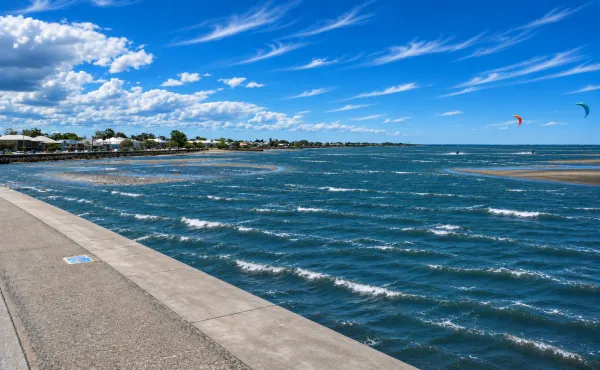
Wellington Point is a well-established flat-water kitesurfing destination on the western shores of Moreton Bay, approximately 25 kilometres southeast of central Brisbane, Queensland, Australia. The spot is characterised by a narrow peninsula extending into the bay, surrounded by extensive tidal flats and shifting sandbanks, including the prominent sandbar connecting Wellington Point to King Island at low tide. This distinctive coastal geography provides riding opportunities on different sides of the peninsula, depending on wind direction and tidal conditions. The protection from open-ocean swell creates predominantly flat to lightly choppy water, making Wellington Point particularly attractive for freeriding, supervised learning and technical progression. Unlike the exposed surf beaches of southeastern Queensland, the spot offers relatively sheltered conditions where riders can concentrate on improving board control, transitions and upwind technique without dealing with significant breaking waves.
One of Wellington Point's main advantages is its ability to accommodate a relatively wide range of wind directions compared with other kitesurfing locations around Brisbane. Easterly and southeasterly winds provide favourable conditions on the eastern side of the peninsula, while westerly and southwesterly winds can be suitable on the western side. Northerly and northeasterly breezes may also offer riding opportunities, depending on the exact launching position. Selecting the correct side of the peninsula is essential to avoid offshore winds and excessive turbulence caused by trees, buildings and surrounding land features. The warmer months, generally from September through April, benefit from seasonal sea breezes and comfortable water temperatures, while winter weather systems can produce stronger westerly and southwesterly winds. Wind speeds commonly fall between 12 and 25 knots during suitable conditions, although stronger frontal systems can generate considerably more powerful and gusty winds. Airflow close to the peninsula can be inconsistent, particularly during launching and landing, but generally becomes cleaner farther away from the shoreline.
Water conditions at Wellington Point are strongly influenced by the tidal cycle. During intermediate tidal stages, extensive shallow sections provide relatively smooth water over the sandy and muddy seabed, creating favourable conditions for practising waterstarts, transitions and controlled freestyle manoeuvres. As the tide retreats, the exposed sandbanks expand considerably, reducing the available riding depth and sometimes requiring a substantial walk to reach suitable water. The shallowest sections should be avoided, even by beginners, because insufficient depth increases the risk of injury during falls. Higher tides generally provide a larger uninterrupted riding area, although the water surface can become more choppy and the available launching space may decrease. When wind direction and tidal height align favourably, the sheltered sides of the sandbanks can offer exceptionally smooth water for freestyle and wakestyle progression. Freeriding remains the most versatile discipline, while hydrofoiling requires deeper sections away from the extensive tidal flats. Stronger winds can provide enjoyable jumping conditions, but adequate water depth is essential. Dedicated wave riding is practically absent because of the sheltered nature of Moreton Bay.
Access to the spot is straightforward via Main Road, which leads directly to Wellington Point Recreation Reserve at the northern end of the peninsula. Public parking, toilets and grassy areas are available close to the shoreline, providing convenient facilities for regular kiteboarding sessions. However, the most appropriate rigging and launching location depends on the prevailing wind direction and tidal stage. At high tide, the combination of narrow beach sections, trees and recreational infrastructure can make launching considerably more technical than the open-water conditions might suggest. Wellington Point is a popular recreational destination for Brisbane and Redlands residents, particularly during weekends, public holidays and school holidays. The sandbar leading towards King Island attracts numerous pedestrians at low tide, requiring kitesurfers to maintain generous separation from people walking across the exposed flats. Boardshorts and a rash guard are generally sufficient during the warmer months, while a lightweight full wetsuit is useful during winter sessions. Protective footwear may be advisable because of shells, occasional rocky patches and submerged debris around the access areas.
The principal hazards at Wellington Point include extremely shallow water, shifting sandbanks, tidal currents, turbulent winds near the peninsula and restricted launching space during higher tides. Riders should carefully assess the available water depth before attempting jumps or powered freestyle manoeuvres, as the apparently smooth surface can conceal dangerously shallow sections. Stingrays and sharp shells may also be encountered across the tidal flats. Particular attention should be paid to wind direction when selecting a launch, ensuring that the session takes place on the appropriate side of the peninsula with a safe recovery route. Strong winter westerlies and summer thunderstorms can introduce sudden gusts and significant changes in wind strength. Beginners should seek professional instruction and local guidance, particularly when unfamiliar with the tidal characteristics of Moreton Bay. With its varied wind exposure, extensive sandbanks and convenient access from Brisbane, Wellington Point is one of southeastern Queensland's most versatile flat-water kitesurfing locations. Its greatest appeal lies in freeriding, freestyle progression and long cruising sessions, provided riders carefully coordinate their sessions with the wind direction and tidal conditions.
Something missing or out of date at this spot? Suggest a correction
This spot does not have a photo gallery yet.
Kited here? Add the first photos (free account, one minute).
Wellington Point is best suited for
Spot profile
- Travel spotA proven kite destination with reliable conditions, worth a trip. Kiters fly in from all over the world for their kite holidays, and you will probably find schools, rentals and a lively kite scene nearby.
- Family spotEasy to visit with family and friends. Facilities are close by and non-kiters have plenty to do while you are on the water, so everyone enjoys the day, whether they kite or not.
- Local spotNot worth a long trip, but a great option if you live nearby and the wind is on. Ideal for a quick session after work or a spare afternoon, without planning a whole trip.
Equipment
A freeride or light-wind twin tip is generally a solid choice for Wellington Point, with a smaller board coming in handy for windier sessions or when there's a bit more chop outside the sandbank. A beginner-friendly setup suits the shallow, sandy conditions well. For wetsuits, a spring suit or shorty is typically enough from late spring through early autumn, while a 2/2 or 3/2 full suit is sensible in cooler months or during winter. Booties are usually not required on the sandy bottom, though some prefer thin shoes around the launch if conditions are rough or if any shell patches are present near access points. On light-wind days, larger kites can extend ride time, but mid-sized kites work best when the trades fill in.
Wetsuit suggestion by month
- JanShorts27°
- FebShorts28°
- MarShorts26°
- AprShorts24°
- MayShorty21°
- Jun3/218°
- Jul3/217°
- Aug3/218°
- SepShorty21°
- OctShorty23°
- NovShorts25°
- DecShorts27°
- 3/2 3/2 mm
- Shorty Shorty or neoprene top
- Shorts Boardshorts and lycra
Based on the average sea temperature of each month. A guide for an average rider: if you feel the cold, go one step warmer.
Wind Conditions
Main wind directions
Windy days per month
Share of the days with more than 10 knots.
Wind speed range
10 - 22 knots
Wind strength on rideable days
- 7-11 kn83%
- 12-16 kn16%
- 17-22 kn1%
- 23-28 kn0%
- 29+ kn0%
Share of the daytime hours with 7+ knots.
Calculate your kite size
Estimate for a rider of your weight at Wellington Point: kite size = weight / wind speed x 2.2, adjusted for the kite shape and aspect ratio. Board, skills and gusts change the ideal size.
Month by month at Wellington Point
| Metric | Jan | Feb | Mar | Apr | May | Jun | Jul | Aug | Sep | Oct | Nov | Dec |
|---|---|---|---|---|---|---|---|---|---|---|---|---|
| Wind | ||||||||||||
| Rideable daysdays | 26 | 23.5 | 22 | 18.5 | 17.5 | 12.5 | 16.5 | 18 | 24 | 27 | 27.5 | 28 |
| Usable windhours | 188 | 176 | 165 | 140 | 138 | 91 | 122 | 122 | 162 | 198 | 191 | 191 |
| Average gustsknots | 21 | 21 | 20 | 18 | 17 | 15 | 17 | 16 | 19 | 21 | 20 | 21 |
| Temperature | ||||||||||||
| Air°C | 26 | 27 | 26 | 24 | 21 | 19 | 18 | 20 | 21 | 23 | 24 | 26 |
| Sea°C | 27 | 28 | 26 | 24 | 21 | 18 | 17 | 18 | 21 | 23 | 25 | 27 |
| Weather and sea | ||||||||||||
| Sunshinehours / day | 11 | 10.5 | 8.9 | 9.7 | 8.7 | 9 | 8.6 | 9.6 | 10.5 | 10.7 | 10.4 | 11.4 |
| Rainmm | 142 | 173 | 330 | 99 | 132 | 25 | 56 | 38 | 44 | 111 | 167 | 119 |
| Rainy daysdays | 19.5 | 14 | 17 | 10 | 11.5 | 4.5 | 7 | 6 | 6 | 10.5 | 14.5 | 15 |
| Wave heightm | 0.5 | 0.6 | 0.6 | 0.5 | 0.5 | 0.4 | 0.4 | 0.5 | 0.5 | 0.5 | 0.5 | 0.5 |
Typical monthly averages over several years, based on weather data: local thermal winds are usually stronger than shown, and sea temperature and waves are a regional estimate. A rideable day has at least 3 hours of 7+ knots between 10:00 and 18:00, usable wind counts those hours, a rainy day has 1 mm or more.
Wind and climate statistics: Weather data by Open-Meteo.com (CC BY 4.0), based on ERA5 data of the Copernicus Climate Change Service. A typical year, not a forecast.
Forecast on Windy.com
Kitesurfing Safety & Local Rules at Wellington Point
The main hazards at Wellington Point, on Moreton Bay near Brisbane, Queensland, Australia, are significant tidal variations and the extremely shallow water covering its extensive sand flats. As the tide recedes, previously rideable sections can become dangerously shallow or completely exposed, increasing the risk of hard impacts during falls, unsuccessful jumps or sudden board catches. Although the predominantly sandy seabed is relatively forgiving compared to rocky or reef-covered locations, insufficient water depth leaves little margin for error. Emerging sandbanks can also divide the riding area into separate sections, complicating board recovery and forcing riders to walk considerable distances. Scattered shells around access points may cause minor foot injuries. Always assess tidal conditions before launching and avoid high-impact manoeuvres wherever water depth is insufficient.
Wind turbulence around the point is another important local hazard, particularly near the launching area, where surrounding land and coastal obstacles can produce sudden gusts, lulls and changes in wind direction. These conditions require reliable kite-handling skills and carefully controlled launches and landings, especially when space is limited. Westerly winds and light easterly conditions can be particularly inconsistent, making it important to assess actual wind quality rather than relying exclusively on forecasts. As the tide rises and the accessible riding area changes, kitesurfers may encounter paddleboarders, small recreational boats and other water users navigating around the sandbanks. Maintain adequate separation, observe established right-of-way rules and avoid riding too close to unfamiliar obstacles or crowded sections of the bay.
Wellington Point is a popular recreational destination shared with families, swimmers, pedestrians and visitors walking across the exposed sandbanks. During weekends and favorable weather conditions, the available space for safe rigging, launching and landing can become considerably restricted. Particular attention should be paid to pedestrians who may cross kite lines or enter launching areas without recognizing the associated risks. Local signage may also indicate restrictions on kitesurfing within specific areas or under certain circumstances, so riders should confirm current access regulations with the relevant council authorities before launching. Ignoring these restrictions or repeatedly creating conflicts with other beach users could jeopardize future kitesurfing access. Careful tide planning, awareness of wind turbulence and responsible beach-sharing are essential to maintaining Wellington Point as a safe and accessible kitesurfing destination.
How to reach Wellington Point
- Closest cityBrisbane
- How to get thereWellington Point is reached by road from Brisbane and the surrounding Redland Bay area, with easy drive access and parking close to the foreshore. The spot is a straightforward day-trip drive from Brisbane rather than a remote travel destination. For visitors arriving by air, the nearest major airport is Brisbane Airport, followed by a drive south-east to Wellington Point.
- AccessThe spot is publicly reachable from the waterfront and foreshore areas, with easy car access and parking nearby. It does not appear to require a special access fee for normal beach use, but local rules may apply and can affect whether kiting is allowed at a given time or place.
No-Wind Days: What to Do Around Wellington Point
Wellington Point, located in the Redlands Coast region southeast of Brisbane, is a charming bayside destination where the suburban landscape gradually gives way to the natural beauty of Moreton Bay. The narrow peninsula extending into the bay is surrounded by shallow waters, mangroves and small islands, creating a particularly attractive setting for outdoor recreation. Although Wellington Point is a popular weekend escape for Brisbane residents, it retains a relaxed, community-oriented atmosphere rather than the commercial character of a major seaside resort. Its combination of coastal scenery, recreational facilities and proximity to Brisbane makes it an enjoyable destination for families and visitors with different holiday interests.
One of the most distinctive attractions at Wellington Point is the opportunity to walk to King Island at low tide. As the water retreats, a natural sandbank emerges, connecting the mainland with this small, uninhabited island. The walk is approximately one kilometre each way and offers beautiful views across Moreton Bay, with opportunities to observe small marine creatures, coastal birds and mangrove vegetation. It is particularly enjoyable for families with children, although checking the tide tables before setting out is essential, as the connecting sandbank disappears beneath the rising water. King Island is a protected conservation area, so visitors should respect its vegetation and wildlife and avoid disturbing the surrounding habitats.
Wellington Point Recreation Reserve is an excellent place to spend a relaxed afternoon by the water. Its large grassy areas, mature fig trees, playgrounds, picnic tables and barbecue facilities attract families throughout the year. The historic jetty is popular with recreational fishermen and offers pleasant views across the bay towards the surrounding islands. Walking around the peninsula reveals different perspectives of the coastline, from sheltered mangrove environments to open expanses of water. The western side of the point is particularly attractive during sunset, when the evening light creates beautiful reflections across the bay. Swimming is possible in suitable conditions, but visitors should be aware of tidal currents, changing water depths and the absence of guaranteed lifeguard supervision.
The village of Wellington Point, situated a short distance inland from the recreation reserve, offers a pleasant selection of cafés, bakeries, restaurants and small independent shops. Its relaxed suburban atmosphere makes it an enjoyable place for a long breakfast or an informal lunch. Nearby Cleveland provides additional dining opportunities, particularly around Raby Bay Harbour, where waterfront restaurants overlook recreational boats and yachts. Cleveland Point Lighthouse, a distinctive nineteenth-century timber structure, is another interesting local landmark. The surrounding parklands and waterfront paths make Cleveland Point a worthwhile destination for a leisurely afternoon exploring the maritime heritage of the Redlands Coast.
Nature lovers can discover several conservation areas throughout the surrounding region. The wetlands around Thorneside, Birkdale and the wider Moreton Bay coastline provide important habitats for migratory shorebirds, while the mangrove forests support numerous marine species. Farther inland, the Venman Bushland National Park offers walking trails through eucalyptus woodland, where visitors may encounter wallabies, koalas and native birds. The IndigiScapes Centre in Capalaba is another interesting destination for families, featuring native botanical gardens, nature trails and educational activities focused on the local environment. These attractions offer an enjoyable contrast to the open coastal landscapes of Wellington Point.
For a more adventurous day trip, North Stradbroke Island, traditionally known as Minjerribah, is easily accessible by ferry from nearby Cleveland. The island is famous for its beautiful ocean beaches, freshwater lakes, coastal walking trails and abundant wildlife. The North Gorge Walk at Point Lookout is particularly spectacular, following rugged headlands overlooking the Pacific Ocean, where dolphins, sea turtles and migrating humpback whales can sometimes be observed. The island also offers opportunities to discover the cultural heritage of the Quandamooka people, the Traditional Owners of the region. With its relatively undeveloped landscapes and relaxed atmosphere, Minjerribah is an excellent destination for a full-day excursion or an overnight stay.
Brisbane itself provides an entirely different range of activities within easy reach of Wellington Point. The South Bank Parklands are particularly attractive for families, with landscaped gardens, riverside restaurants and the popular Streets Beach swimming lagoon. The Queensland Museum, Gallery of Modern Art and Queensland Art Gallery offer interesting cultural alternatives, while the city's markets, shopping districts and entertainment venues provide plenty of variety. Taking a CityCat ferry along the Brisbane River is an enjoyable way to discover the city's architecture and waterfront neighbourhoods without spending the day walking through busy streets.
Accommodation around Wellington Point consists primarily of holiday rentals and smaller establishments, with a broader selection of hotels, motels and serviced apartments available in Cleveland and the eastern suburbs of Brisbane. Visitors can also stay in central Brisbane and travel to Wellington Point using the suburban railway, although reaching the recreation reserve from the station requires an additional walk or local transport. A rental car provides greater flexibility for exploring the Redlands Coast and surrounding conservation areas. During sunny weekends and public holidays, the recreation reserve can become particularly busy, and parking spaces near the waterfront may be difficult to find.
Wellington Point is an excellent choice for a family kitesurfing holiday near Brisbane, particularly for travellers who enjoy combining outdoor activities with urban sightseeing. Walking across the sandbank to King Island, discovering the natural beauty of North Stradbroke Island or simply enjoying a picnic beneath the fig trees are all rewarding ways to spend a windless day. For non-kiting partners, the combination of Moreton Bay's coastal landscapes, the relaxed character of the Redlands Coast and the cultural attractions of Brisbane ensures that there is considerably more to discover than the beach itself.
Riders of Wellington Point
Who calls Wellington Point home, who is planning a trip and who has ridden it. Add yourself to meet them.
Nobody calls it home yet
Make it my home spotNobody on the way yet
I want to goBe the first to ride it
I have been hereUpcoming at Wellington Point
Sessions, downwinders and meetups planned by the riders of Wellington Point. Going too? Join them.
No session planned yet. Going out soon? Post it: the riders who follow Wellington Point get a notification.
Other kitesurfing spots near Wellington Point
All kitesurfing spots in Australia
Last updated: